Who Walks When? The Complete Wedding Processional Order
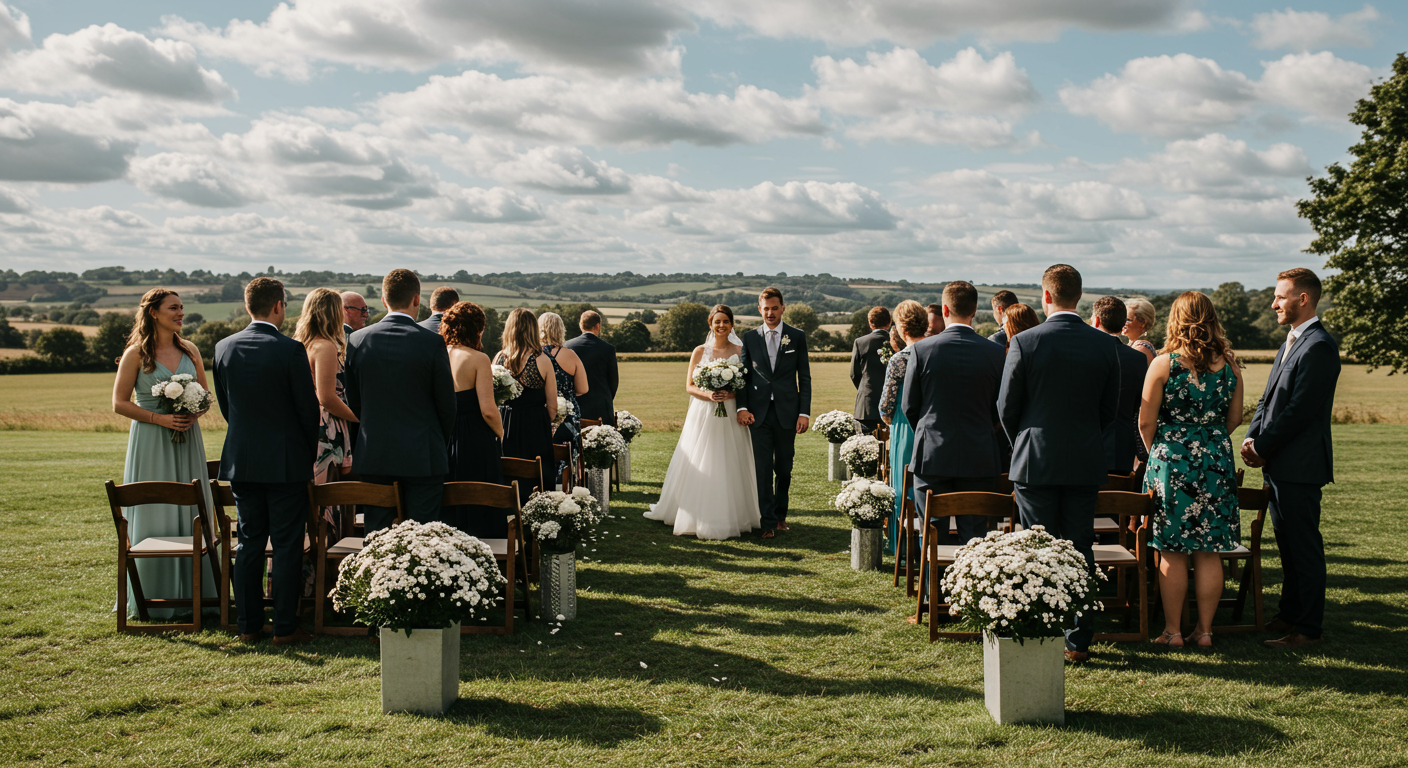
The typical order of wedding processional begins with the officiant, followed by the wedding party (groom first, then groomsmen, bridesmaids, flower girl and ring bearer, and finally the bride with her escort), culminating in the couple’s entrance as husband and wife.
Planning a wedding ceremony is equal parts logistics and legacy. Every step, from the first note of music to the final “I do”, carries symbolism, tradition, and intention. Having documented countless ceremonies across the country, here is what we’ve learned: the processional isn’t just a walk down the aisle, it’s the first chapter of your shared story, captured in real time and remembered in still frames. A well-structured processional supports emotional storytelling, reduces last-minute stress, and gives photographers the rhythm they need to anticipate decisive moments.
That’s why I begin every wedding session, not with a camera, but with a 15-minute Story-First Shoot discovery chat. We talk about what makes your aisle walk meaningful: Is it the grandmother who taught you to waltz? The guitar your dad played at your first date? The quiet strength in your partner’s hand as you pause at the top of the aisle? That conversation shapes everything, lighting choices, composition, timing, even how I frame the processional’s emotional crescendo.
Key Takeaways
- The officiant traditionally enters first, signaling the formal start of the ceremony and establishing sacred space before any guests or wedding party arrive.
- Same-sex and nonbinary couples often adapt the processional order to reflect mutual entry, side-by-side walks, or choreographed group entrances that honor their identity and values.
- When children are included, whether as attendants, siblings, or stepchildren, their placement in the processional should prioritize comfort, visibility, and emotional safety over rigid tradition.
Understanding The Symbolism Behind The Processional Order
The wedding processional is one of the most choreographed yet emotionally raw moments of the day. It’s not just about who walks when, it’s about intention, symbolism, and narrative arc. In many Western Christian and civil traditions, the order reflects a journey: from separation to unity, from individual identity to shared commitment.
The officiant’s entrance is often overlooked, but it’s foundational. They enter first not as a performer, but as a witness and guide. Their presence signals that the space has shifted from social gathering to ceremonial ground. This quiet moment, often accompanied by hushed music or silence, is where anticipation begins to gather like breath before a note.
Then come the attendants. Groomsmen typically precede bridesmaids, not as a hierarchy, but as a practical rhythm: the groom’s party “holds space” before the bride’s enters. This subtle sequencing builds visual contrast, dark suits against light dresses, and creates natural pauses for photographers to capture reaction shots from family and friends.
The flower girl and ring bearer follow, embodying innocence and promise. Their walk is rarely about perfection, it’s about presence. We’ve learned to shoot these moments not with tight framing, but with environmental context: the wobble in a tiny step, the grip on a basket, the way sunlight catches a lifted chin. That’s where authenticity lives.
Traditional Processional Sequence: A Step-By-Step Breakdown
Let’s walk through the most widely recognized sequence for a heterosexual, faith-adjacent or civil ceremony. This is the baseline many couples use as a starting point, then personalize with meaning.
Officiant
Enters first, usually through a side entrance or from the front. Often stands at the altar or podium and faces the congregation. No music is required, but soft instrumental cues are common.
Groom And Parents
In many traditions, the groom walks in with both parents, mother on his right, father on his left, or sometimes just his mother. This signals familial support and continuity.
Groomsmen
Enter in pairs or singly, spaced evenly. They position themselves at the altar, typically on the groom’s right (from the audience’s perspective, that’s stage left).
Bridesmaids
Enter next, usually in pairs, often with a groomsman. If there’s an uneven number, the maid or matron of honor walks alone, or with the best man. Their placement mirrors the groomsmen: on the bride’s left (audience’s right).
Maid/Matron Of Honor
Enters last among the attendants, often pausing slightly before joining the line. She stands directly to the bride’s left.
Flower Girl & Ring Bearer
Typically walk together, though some couples separate them for pacing or safety. The ring bearer may carry a faux ring box or a pillow, many now opt for symbolic tokens (a family heirloom, a handwritten vow card) instead of actual rings.
Bride And Her Escort
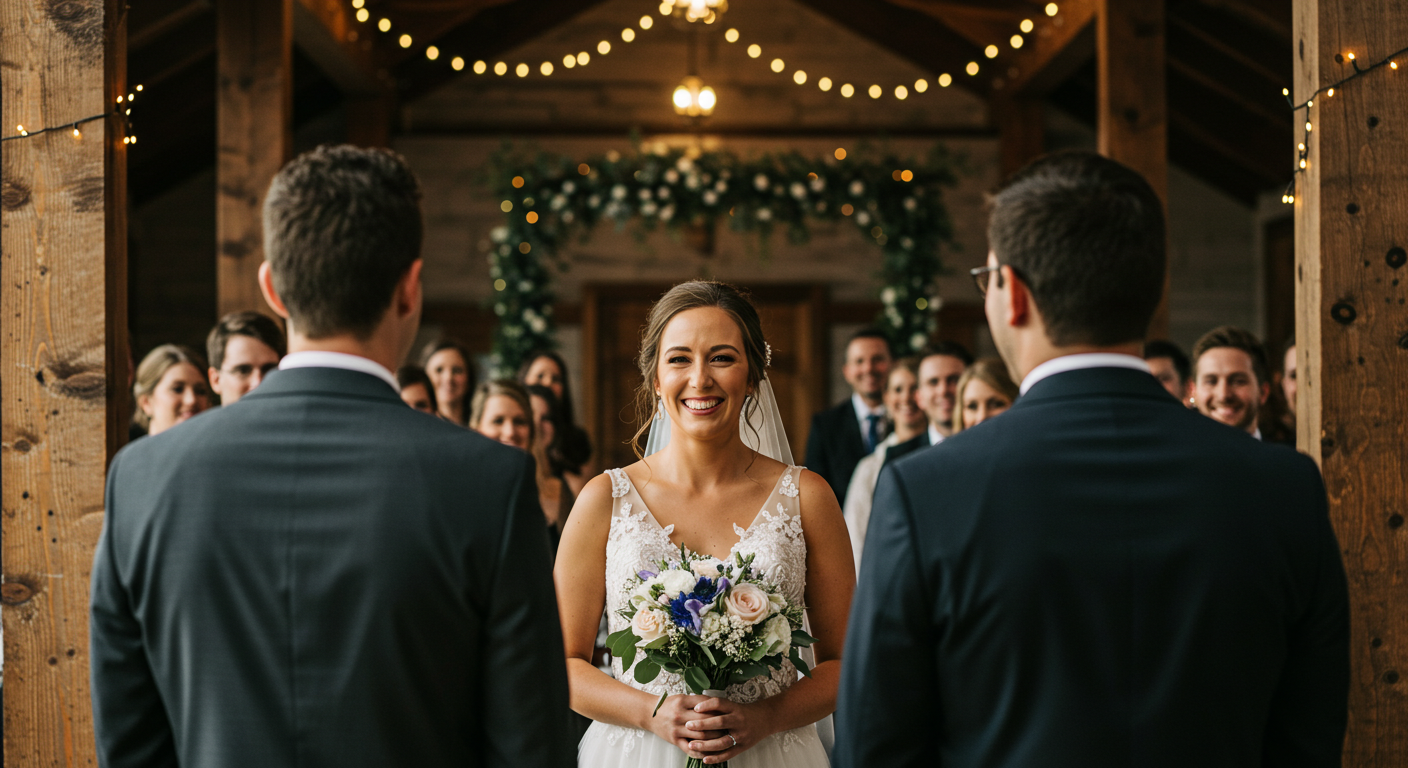
The grand finale. She walks with her father, stepfather, both parents, or another chosen person. Some walk solo, especially in nonreligious or feminist ceremonies. The moment she reaches the altar, the music swells, and the ceremony begins.
Note: This is not universal. In Jewish ceremonies, for example, the bride circles the groom seven times after the processional, symbolizing the creation of a shared world. In Hindu weddings, the groom arrives on horseback or in a decorated vehicle, and the bride’s entrance is accompanied by rhythmic clapping and ululation.
Modern Adaptations And Inclusive Variations
Tradition is a living language, not a rigid script. Today’s couples are rewriting the processional with intention, identity, and joy. We’ve witnessed, and documented, how flexibility in order unlocks deeper storytelling.
Same-sex couples often choose parallel processions: both partners enter from opposite sides and meet at the center. Or they walk in together, arms linked, music swelling as they step side-by-side toward the officiant. No “bride” or “groom” labels, just two people claiming their space, equally.
Nonbinary and gender-expansive couples might invite all attendants to walk together in a single, flowing line, no pairing, no hierarchy. Some couples have their entire wedding party enter holding hands, forming a living arch the couple walks beneath. It isn’t “nontraditional”, it is their tradition.
Families with blended children often adjust timing and placement to affirm belonging. A 10-year-old stepson may walk with his stepmother before she enters, giving him a visible, honored role. A toddler daughter may ride in a wagon pulled by her older brother, rather than walk alone. These aren’t deviations, they’re declarations.
And for interfaith or multicultural ceremonies, the processional becomes a bridge. In a Sikh-Christian wedding, for example, the groom might enter to the rhythmic beat of the dhol, then pause as the bride enters to a cello rendition of “Ave Maria.” The fusion isn’t performative, it is prayer in motion.
Cultural And Religious Variations You Should Know
Wedding processional customs are deeply rooted, not in etiquette manuals, but in theology, geography, and generational memory. Understanding these contexts helps couples honor heritage and adapt with integrity.
Jewish Weddings
The processional is often split: the groom (chatan) walks down the aisle first with his parents, followed by the bride (kallah) with hers. In many Reform and Reconstructionist ceremonies, both sets of parents walk together. The chuppah, the cloth canopy, represents the couple’s new home, and the entire processional moves toward it, not just to it.
Hindu Weddings
There’s no single “aisle” in the Western sense. The groom arrives first, sometimes on a decorated horse or in a procession called the baraat, accompanied by dancing, singing, and drumming. The bride enters later, often carried on her father’s shoulders or walking slowly beneath a floral arch. Her entrance is considered auspicious, and guests may scatter petals or rice.
African American Ceremonies
The processional often includes the “jumping the broom” moment, but that usually happens after vows, not during entry. Still, many couples incorporate ancestral acknowledgments: a moment of silence for elders, the playing of a spiritual, or the inclusion of a Kente cloth draped over the arch. The order may pause for a libation or spoken tribute, honoring lineage before stepping into covenant.
Filipino Weddings
The “candle ceremony” and “veil ceremony” occur during the service, but the processional often features the sablay, a woven stole placed over the couple’s shoulders by their parents, symbolizing unity and blessing. Attendants may carry candles or flowers arranged in traditional sampaguita (jasmine) garlands.
None of these require full adherence, but each offers symbolism you can borrow, adapt, or reinterpret. My Story-First Shoot methodology always begins by asking: Which of these moments feels like yours? Which one makes your breath catch?
How Lighting And Timing Affect Processional Photography
As a natural light specialist, I don’t just photograph the processional, I orchestrate for it. Because light shapes emotion. A backlit silhouette at the top of the aisle reads as reverence. A shaft of golden hour light catching a tear mid-step reads as tenderness. And flat, overhead fluorescent light? It reads as anonymous.
That’s why scouting is non-negotiable. I visit every ceremony venue 48–72 hours before the wedding, not to check Wi-Fi or parking, but to map light: Where does the sun hit at 4:15 p.m.? Where is open shade? Where does the window light pool at golden hour? I note reflections on glass doors, glare on polished floors, and how candlelight interacts with sheer veils.
For indoor venues, I use reflectors, not flashes, to bounce ambient light onto faces. A silver reflector adds crispness; a white one softens. A 5-in-1 collapsible disc fits in my bag and takes 90 seconds to deploy. No pop, no startle, just gentle, dimensional illumination.
Timing matters just as much. I never shoot the processional in “real time.” Instead, I anticipate:
- The 3-second pause before the bride steps onto the aisle.
- The micro-expression as she sees her partner for the first time during the walk.
- The way her escort’s hand tightens, just once, before releasing.
That’s the Candid Edit Framework in action: editing not for perfection, but for emotional fidelity. I adjust exposure to preserve shadow detail in a lace sleeve, not to “fix” dim light. I remove a stray leaf on the floor, not a natural wrinkle in a sleeve. And I sequence images to build narrative: wide shot → medium → tight detail → reaction.
Common Mistakes To Avoid In Processional Planning
Even with the best intentions, processional planning can unravel. Here’s what I’ve seen, and how to prevent it.
Skipping A Rehearsal Walk-Through
A 10-minute rehearsal isn’t about memorizing steps, it’s about muscle memory. Where does the flower girl stop? How many steps does it take the bride to reach the center? Does the ring bearer need a stool? Without practice, the processional becomes a series of micro-panics, visible in stiff shoulders and forced smiles.
Overloading The Aisle
More isn’t more. Eight bridesmaids, six groomsmen, two flower girls, three ring bearers, and two sets of grandparents creates visual clutter, and logistical gridlock. Consider grouping: have attendants enter in threes, or have some wait at the front and join the line after the bride arrives.
Ignoring Accessibility
A 200-foot carpeted aisle may be romantic, but not for a grandparent with a cane or an attendant using a wheelchair. A simple fix is to replace the aisle runner with a wide, low-pile rug and add a side ramp. Some officiants welcome guests by naming accessibility as an act of love, not an afterthought.
Forgetting Sound Design
Music volume matters. If the string quartet swells too early, you’ll miss the whispered “you look beautiful” between partners. If it’s too quiet, the shuffling of feet dominates. Work with your musicians to time swells to arrivals, not just cues.
Underestimating Transitions
The processional ends, but the ceremony hasn’t started. There’s a 45–90 second gap between “Bride has arrived” and “Dearly beloved…” That silence is sacred. Don’t rush it. Let the air settle. Let the photographer capture the quiet awe before the words begin.
Frequently Asked Questions
Q: What is the usual processional order for a wedding?
A: The usual processional order begins with the officiant, followed by the groom and his parents, groomsmen, bridesmaids, maid of honor, flower girl and ring bearer, and finally the bride with her escort. This sequence builds anticipation and visual rhythm, though many couples now adapt it to reflect personal values, family structure, or cultural tradition.
Q: What is the 50 30 20 rule for weddings?
A: The 50 30 20 rule is not a formal wedding planning standard. It’s sometimes misapplied from personal finance (allocating 50% to needs, 30% to wants, 20% to savings) but has no verified origin or widespread adoption in wedding industry practice. Couples should prioritize budget decisions based on their values, not arbitrary ratios.
Q: What is the 30-5 rule for weddings?
A: The 30-5 rule is not an established wedding planning principle. It may refer informally to allocating 30 minutes for guest arrival and 5 minutes for latecomers before ceremony start, but this is situational, not standardized. Venue logistics, weather, and guest demographics matter more than fixed time rules.
Q: What are 7 marriage vows?
A: There is no universal set of “7 marriage vows.” Traditional vows in many Christian denominations include promises to love, honor, cherish, comfort, protect, forsake all others, and remain faithful “for better or for worse.” But civil, interfaith, and secular ceremonies use personalized vows, and length varies widely by couple, faith, and jurisdiction.
Q: How long should the wedding processional take?
A: A well-paced processional typically lasts 3–5 minutes total. The bride’s walk alone is usually 30–90 seconds, depending on aisle length and tempo. Slower, more deliberate pacing enhances emotional resonance, and gives photographers time to capture layered moments without rushing.
Conclusion
The typical order of wedding processional is less about rigid rules and more about resonant rhythm. It’s the first shared breath before the vows. The first time your story becomes visible, to guests, to your partner, and to the lens that will hold it for decades.
Whether you follow tradition, reinterpret it, or write something entirely new, what matters is that every step feels like yours. As a photographer grounded in Natural Light Mastery and the Candid Edit Framework, I don’t capture poses, I capture presence. I don’t chase perfection, I honor the pause, the glance, the hand that trembles just once.
Because the most powerful wedding images aren’t the ones where everything is flawless. They’re the ones where everything is true.
Ready to capture your special moments? Contact Candid Studios today for a free consultation.
Related: wedding ceremony line up order
Frequently Asked Questions
What Should We Know About Who Walks When? The Complete Wedding Processional ?
Focus on coverage hours, deliverables, and day-of timeline fit before you book.
How Do We Book With Candid Studios?
Share your date and venue via contact. We serve Florida, Ohio, Illinois, Colorado, Texas, and New York.
Explore wedding photography or contact Candid Studios.